The Ancient House
List Entry Summary
This building is listed under the Planning (Listed Buildings and Conservation Areas) Act 1990 as amended for its special architectural or historic interest.
Name: THE ANCIENT HOUSE
List entry Number: 1292809
Location
REAR of 65 AND 67, HIGH STREET – THE ANCIENT HOUSE, HIGH STREET
The building may lie within the boundary of more than one authority.
County: Kent District: Tonbridge and Malling District Type: District Authority
Parish: West Malling
Grade: I
Date first listed: 01-Aug-1952 Date of most recent amendment: 14-Oct-1996
Legacy System Information
The contents of this record have been generated from a legacy data system. Legacy System: LBS UID: 392348
Asset Groupings
This list entry does not comprise part of an Asset Grouping. Asset Groupings are not part of the official record but are added later for information.
Details
TQ 6957 WEST MALLING HIGH STREET 3/16 Numbers 65, 67 and The Ancient House 1.8.52 GV I Shops and storeroom, possibly originally priest’s house to nunnery, other building in monastic ownership or merchant’s house, later inn and jail.
The Ancient House is circa 1160-80, with some possible 14th Century alterations, reroofed circa 1460 and refenestrated in early 19th Century. Nos. 65 and 67 are 15th Century. Number 67 was rebuilt in the 17th Century but with a link block to the Ancient House, probably 16th Century, refenestrated in the mid-19th Century. The Ancient House was originally a chamber block above an undercroft with an external staircase no longer extant and possibly part of a larger structure.
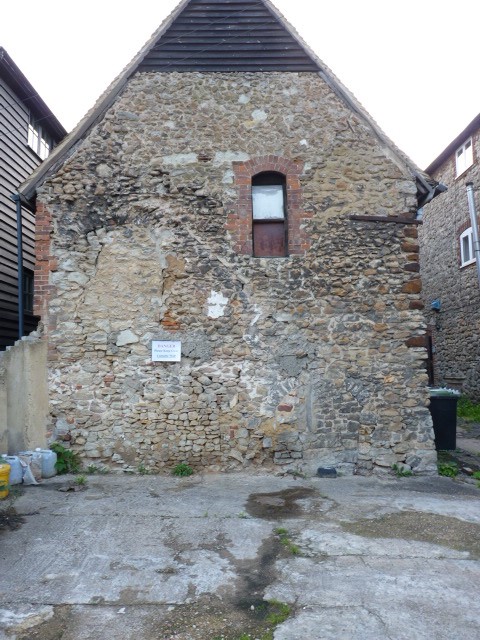
Built of ragstone rubble and some tufa blocks with roughly quoined corners. Tiled roof and one 19th-century brick chimney stack. Two storeys. North front has 2 19th-century inserted casements with brick dressings. Ground floor has a 14th or 15th-century blocked pointed arched doorcase to the ground floor left, which led to the undercroft, and a low-positioned medieval blocked rectangular stone window opening. There is also a later doorcase with 20th Century door and 19th Century inserted plank door and adjoining casement.
The East wall has part of a low semi-circular tufa arch remaining, indicating an external staircase. Lack of evidence for windows on west end wall suggests there may have an earlier hall on the site of current 16th Century link block. Interior first floor chamber contains two windows of c1160-80 with chevron arches and scallop caps to first floor, a 15th Century stone chimney piece with wooden bressumer and intact 15th Century sans-purlin roof with 3 tall chamfered crownposts with four headbraces. The crownposts are similar in type to Old Gilwyn’s Chiddingstone, dated to c. 1460.
Evidence from a former inhabitant suggests there may be an undercroft with a wooden access trap. The front part of numbers 65 and 67 is timber-framed, refronted in stucco, with an old tiled roof with a central brick chimney stack. Two storeys and attics. Number 65 has 2 casements to the first floor and a 19th-century shopfront. Number 67 has a second floor mid-19th Century sash with verticals only, moulded architrave, first floor 3-light canted bay on brackets and 20th Century shopfront.
The Link block between the front of number 67 and The Ancient House is timber-framed, underbuilt in red brick on the ground floor and with a tiled roof. Internally, the link block of number 67 has a 16th-century chamfered beam and roof of collar rafter type. Number 67 has a 15th Century stone fireplace to first floor front room with mid-19th cast iron fire grate, exposed 15th or early 16th framing with lambs tongue stops, the top of a medieval doorframe, 3 plank door and the attic contains 15th octagonal crownpost to front range with moulded top and base and 4 headbraces to collar beam. Side-purlin roof.
Deeds of 1681 show that at least part of the property was known as “the Angel, formerly the Bull” and an inn called the Bull was mentioned as being well established by 1442. Use as an inn would explain why grand heated chambers were being created in two parts of the property in the mid-15th Century. Domestic buildings of the 12th century are very rare in the southeast and rare nationally.
Books and journals
Crozier, P, Survey of Buildings in West Malling
Newman, J, The Buildings of England: West Kent and the Weald, (1980), 578-579
Wood, E, The English Medieval House, (1965), 6 14 32 33
Royal Commission Report no. 91016 by Sarah Pearson 1996
© https://historicengland.org.uk/terms/website-terms-conditions/